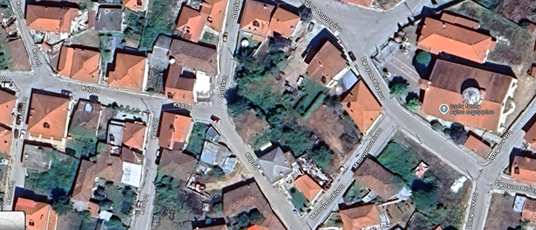


The building is a listed monument and is located in a central part of K. Nevrokopi. It was built in 1860 and is one of the most representative examples of the traditional architecture of the area and is connected to historical and social events of the settlement. It was used as a summer residence of the Metropolitan of Nevrokopi and as a hidden school during the Macedonian War, when in 1903 the school of Nevrokopi ceased to function.
The building is stone-built with a wooden roof with Byzantine-style tiles. On the floor, the north-east and south-west walls are made of chatma. On the ground floor there are three rooms and on the upper floor the basic typology is followed with the airy central space, on either side of which four rooms and the kitchen are formed. The communication of the ground floor with the upper floor is ensured by an external wooden staircase, which is delimited by a wall of chatma. Due to its relationship with the building, it is likely that it is an old construction-addition. The load-bearing masonry is mudstone construction (limewashed on the outside) with binding lime mortar, with an average thickness of about 60cm. on the ground floor and 50 cm. on the floor. In the middle of the main facade there is a wooden raised porch, which is supported by wooden struts and covered by a roof extension. Similar struts carry the two corner chamfers. The parapet of the porch consists of a continuous covering of boards, which blocked the view from the road to the house. The building is covered by a four-pitched roof with a load-bearing frame made of chopped tree trunks, wooden cladding and Byzantine-style tiles. On the back side of the building, the addition of the kitchen at floor level was most likely done later. It is a composite construction of a lightweight concrete slab and masonry of timber ties, adobe, solid and perforated bricks. Into the volume of the kitchen is incorporated the wooden roof of the corresponding ground floor building made of mudstone where the house’s oven used to be. All frames are wooden. The windows have glazing bars and balustrades with horizontal iron bars. The ground floor windows facing the building have nailed covers. The ground floor door is wooden studded.
The courtyard of the building was enclosed by a high stone wall of 4.00 square meters. The entrance to the courtyard is formed by a double wooden studded door and a wooden canopy with a four-pitched tiled roof. In the yard were the stable, storeroom and barn, which have been demolished. The sidewalk in front of the building, as well as the entrance to the house, are paved with the same slabs that are on the ground floor of the building. At the time of the Service’s engineer’s proposal (2005), the building was kept in relatively good condition, which could be repaired. The additions that had been made to the courtyard view had not altered its original structure.