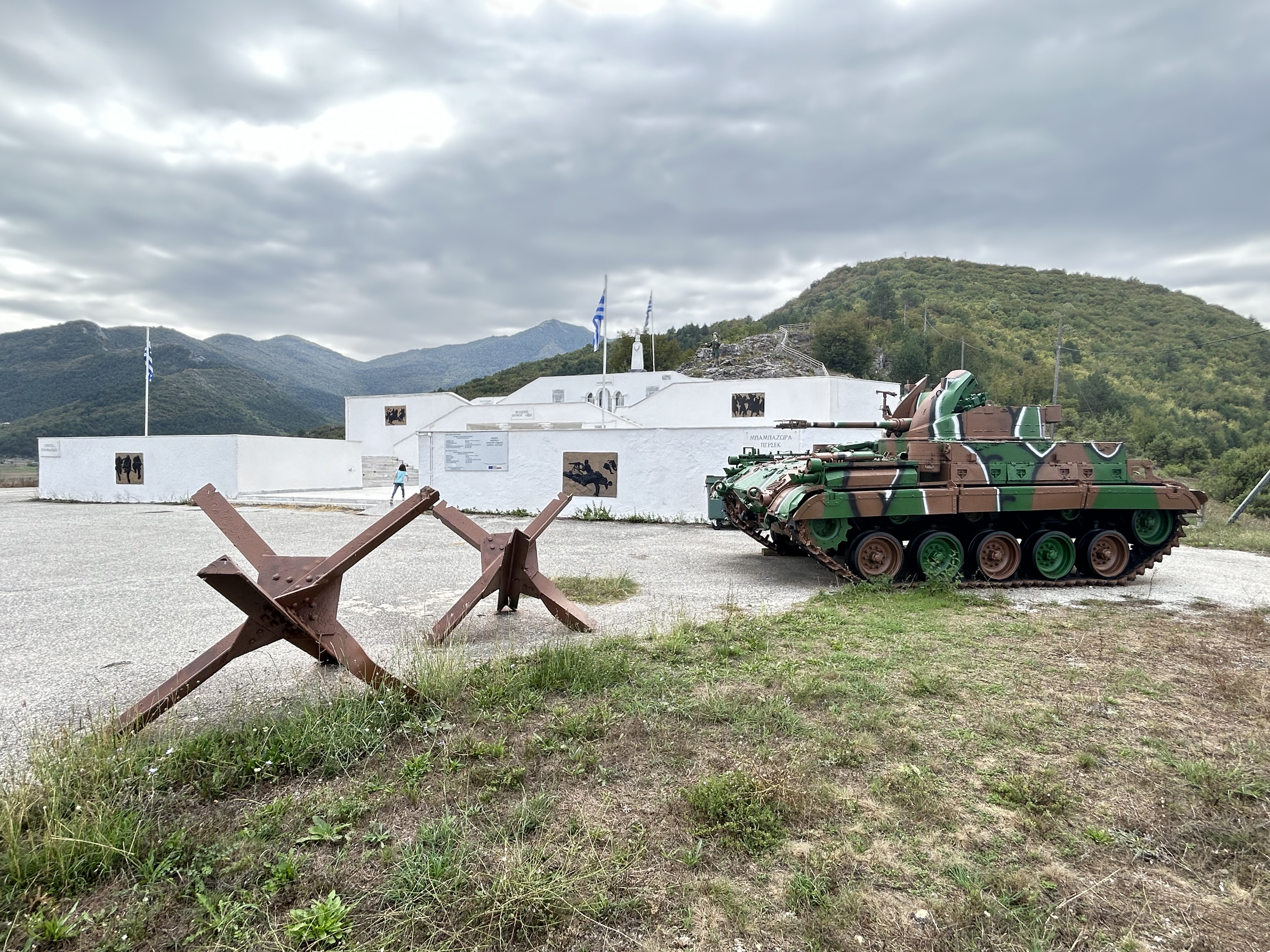


The Lisse fort is part of the Metaxas Line and is located a short distance east of the village of Ochyro and about 2 km from the town of Nevrokopi, inside the hill that rises in the plain of Nevrokopi. The fort was named Lisse from the old name of the adjacent village, which received the name Ochyro. Names were exchanged.
Its fortifications consist of four groups of galleries (Turtles) along the entire length of the hill, with underground galleries that exceed 950 meters in total. Two of the gallery complexes communicate with underground passages, while the other two are autonomous defense installations.
The Fort had cannons, accommodation and storage facilities, water tanks, generators, armament and positions for military vehicles. The strength of Lisse Fort consisted of 12 officers and 457 hoplites.
Due to the necessary secrecy and the need for camouflage, the Fort’s facilities are inconspicuous from the outside, and access to several of its entrances is difficult. Only one Turtle can be visited today.
In these forts the Greek Army fought valiantly against the German and Bulgarian divisions on April 6 to 9, 1941. Despite the fierce efforts and attacks of the invaders, the forts were not captured and finally surrendered on April 10, 1941, after the capitulation of Greece. Many Greek divisions withdrew in an orderly manner and with their armaments. The Germans gave honors to the heroes of the forts at their surrender. After the end of the siege, the Germans wanted to learn the secrets of the construction of the forts from the Greeks themselves who successfully repelled all their attacks. Major Georgios Detorakis, commander of the Lisse fort, refused any cooperation.
In memory of this battle and to honor the dead, a small Museum has been erected. The Museum has been renovated in 2002 and is open to the public.
In the simple and functionally designed interior of the Museum, samples of individual weapons of the Second World War era are exhibited, such as revolvers, pistols, rifles, submachine guns and automatic weapons, mainly of German and Italian origin. Group armament is represented by a range of MG, Brenda and Hotchkiss type machine guns and machine guns. Of particular interest is the collection of mortar systems and the wide variety of shells and projectiles.
A special place among the exhibits of the Museum is held by the medals awarded to Officers who played an important role in the battle of the Fort, as well as their uniforms. In the center of the Museum there is a model of the geographical location of the battle, where the visitor can watch it audio-visually.