

It belongs to the customs that revive mainly with the end of the Twelve Days, the Lights and talk about the prosperity of the new year. It contains within it the Dionysian cult, pagan elements and much more from the passing of the centuries until today.
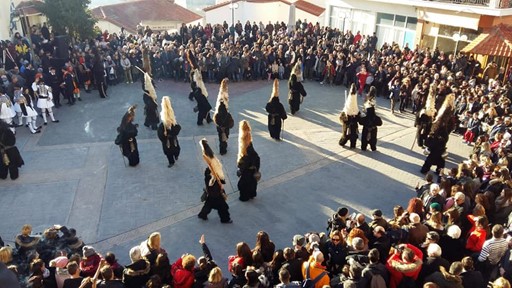
In Monastiraki, the disguises take place on Epiphany day, with the appearance of the Arapids. There are also groups of men, some of whom are dressed as choliadas, and others who wear the local women’s costume, the Girls or Giliges, as they are called. The main protagonists of the action, the Arapides (Carnivals), have their faces smeared with charcoal powder or covered with black cloth, and are dressed in long woven capes and high goatskin hoods on the head, which also cover the face, with open holes for the eyes and the mouth. They have bells hanging from their waists and hold a wooden sword in one hand and a bag of ashes in the other. The group, Cheta as it is called, also has two trusted faces, who are not disguised, the so-called Chetabassides and they go around the whole village from the morning of the day, dance in front of every house and wish for good health and a rich harvest. The dance is accompanied by lyre and daere (tambourine).
In the afternoon, everyone gathers in the village square and a wild dance follows. Participating in the Trano Circular Dance of the central “square”, strengthens and consolidates the performers and animators in their self-confidence and attitude to life so that they continue their efforts to serve this particular primordial ritual, with all its symbolism, which aims in Eveteria, i.e. the Good Year and fertility
The music and dance event continues to function unchanged and authentic, thus strengthening the belief that in Monastiraki they are saving an ancient tradition, which is transferred, transferred and transmitted experientially and authentically to the younger generation.