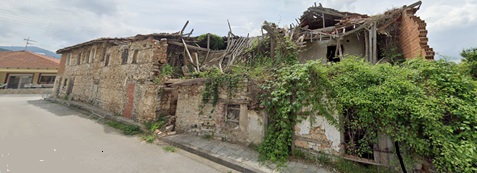


The building is a listed monument and is located in a central part of K. Nevrokopi. It was built in successive phases from 1840 onwards. This house housed the offices of the first community of the village after its liberation from the Turks. The old inscription of the first Community Shop can still be seen on the main facade.
The dimensions of the building are approximately 9.00×33.00 m and it consists of a first floor and a ground floor. It is stone-built with a wooden roof and Byzantine-style tiles. The building is a development of an original core in the northeast which was then integrated into the overall construction. It is a residence with a particularly elongated rectangular floor plan that takes the form of a P, which is orthogonal with the two-story loggia towards the courtyard. On the ground floor there are six spaces with larger ones at the two ends of a rectangular plan and the four in retreat creating a semi-outdoor space. The layout of the ground floor is followed on the first floor. The loggia rests on wooden supports and furousia. The ground floor is connected to the first floor with two stone and one wooden staircase on the western side of the building – internal to the courtyard. In the northern part of the eastern face towards the street, traces of another staircase are preserved. The entrance to the first floor spaces is through the loggia, which is a key architectural element of the building and was a space of vital importance for the lives of the house’s occupants. In it, the summer semi-outdoor accommodation and many agricultural works were done, mainly the rolling of tobacco. The outer walls towards the side of the courtyard as well as the inner ones are made of chatma and are plastered with lime plaster reinforced with goat hair and painted in white, green-indigo and ochre. All the frames of the building are wooden. The windows have glazing bars and balustrades with horizontal iron bars. The doors of the ground floor are wooden nailed, while the rooms of the first floor are paneled with decoration. The entrance to the building is through a large double door, which through a corridor leads to the courtyard.
The door on the south side of the building, which has a roof with Byzantine-style tiles, also leads to the courtyard. All the upstairs rooms had fireplaces. The building is covered with a four-pitched wooden roof with a load-bearing frame made of hewn carp logs. There is wooden cladding and tiling with Byzantine-style tiles. The yard of the building, with an area of approximately 180 m2, is fenced off by a stone retaining wall 2.5 m high and 70 cm thick and divided into two sections also by a stone retaining wall, which was built later when the old property was divided into two smaller ones. In both parts of the courtyard there are stone ovens. At the time of the documentary report (2005) the building was maintained in a moderate condition. The damages were found in its wooden elements while the individual interventions had partially altered its original form and structure, without affecting their basic principles. The entire structure was in need of repair and restoration.