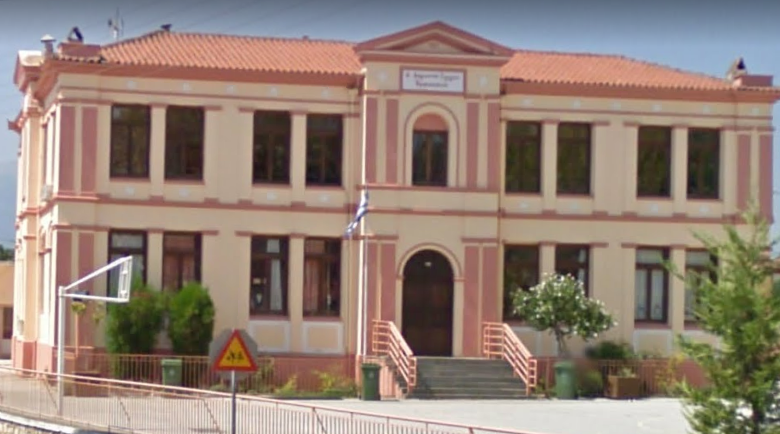


The construction of the building was completed in 1909. It housed the Urban School for Boys and the Girls’ School. Each school was occupied by one level, without internal communication. The building is developed on three levels: semi-basement, ground floor and first floor. The entrance to the ground floor (Virgin School) was on the south side, while that of the first floor is in the center of the east side. Opposite the first-floor entrance door and above the landing of the inner staircase is a built-in marble slab framed by a wavy band, on which is an incised inscription with a text similar to that of the schools of Drama. The floor plan is Π-shaped, with dimensions of the outer perimeter of 18.20×15.00×15.23m. The rooms are arranged side by side and access to them is made from a 2.00 m wide corridor. which follows the interior sides of the building, from which it is illuminated. The layout of the spaces is similar on each level, which includes four large classrooms. On the ground floor, the original entrance was removed when the two levels were unified. For this purpose, the length of the northeast hall was reduced. On the first floor, the two halls of the northern wing had the possibility of unification, through three openings (1.30m wide which have been removed), to create a large event hall. At the same time, the length of the hall corresponding to the northern part of P was reduced and an auxiliary space was created at the end of the corridor. Also, the southeast hall was divided into two parts, which are now used as an office and an instrument room. Despite these modifications, the typology of the floor plan is recognizable, while the form of the facades remained unchanged, except for the abolition of the entrance to the Girls’ School. The building is stone-built and covered with a tiled roof. The thickness of the stonework of the ground floor is 0.60m, while on the first floor it is reduced by 0.10m. The interior walls are of brickwork. The semi-underground space is not open to visitors in its entirety. Only part of the floor plan is used and the entrance to it is made from the inner side of P
Today, the 1st Primary School of Prosotsani is housed in the Tuition Building. The building is surrounded by an extensive free space and marks the area, as its main sides project onto two central road arteries of the town.