

The traditional event of Kalogeros is organized by the Municipality of Prosotsani, the Local Community of Mavrolefki and the Cultural Association of Mavrolefki “Saint Panteleimon”, on Tyrini Sunday.
Its roots can be traced back to ancient eutheric rites, in which people asked the higher forces to act on vegetation and fertilize the earth. Nowadays, the custom reminds and emphasizes the dependence of man on nature. The custom came to Drama with the refugees of Eastern Thrace.
According to the general framework of the ritual formality, the Kalogeros in each house ostentatiously rings his bell, wishes a happy new year and forms the sign of the cross in the yard with a sponge (an auxiliary tool of the home oven). The housewife sprinkles him with polyspora, a mixture of all the agricultural products that the place produces.
At the same time, with the visits of Kalogeros, there are also visits by the other members of the troupe. Laughter, shouts and teasing characterize this phase of the action. Afterwards, everyone gathers in the square and there is a kind of tug-of-war between the young and the middle-aged of the village. The competition ends with the victory of the youth and this is considered to portend the good fortune of the year.
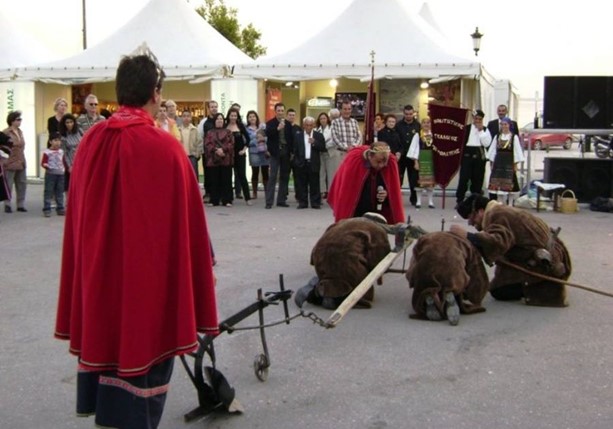
Then the main phase of the action begins. The young men of the village live like heifers and start plowing. In the main phase of plowing, the plow is directed by Kalogeros. Abandoning the jokes, he earnestly performs the sacred plowing. Next is sowing. Each time they throw a seed on the ground, the couple also says a wish, which the gathered crowd repeats with a shout.
After plowing and sowing, the “death” of the protagonist follows: they offer three mouthfuls of food to Kalogeros and then throw him down, supposedly killing him. He pretends to be dead. The young men drag him and with his body he plows the place, where a little while ago they plowed and sowed. The spirit of vegetation and euphoria that Kalogeros represents must remain in mother earth.
Then they throw Kalogeros into water and he comes back to life. Death is followed by life. Fruiting will come again with spring. The New Year is sure. The custom is completed with a circular dance on the organized and sown earth.